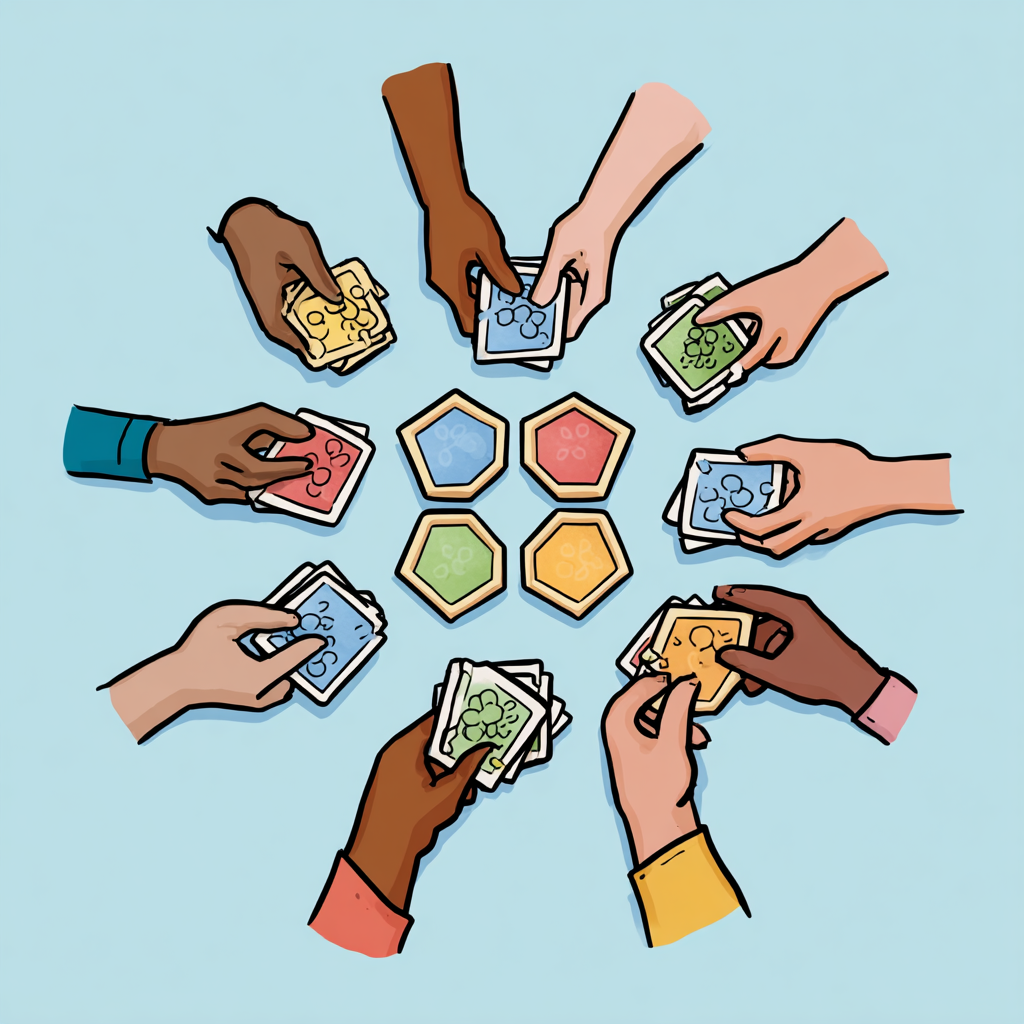
How Board Games Work in Groups Where People Do Not Enjoy Open Competition?
Not every group wants a winner in the center of the table.
Some people enjoy board games most when the evening feels shared, relaxed, and socially safe. They do not want to bluff aggressively, attack each other directly, or spend two hours proving who made the best decisions. They may still like structure, rules, and playful tension. They may still enjoy challenge. What they do not enjoy is open rivalry as the main emotional engine of the night.
This is more common than board game culture sometimes admits. A lot of game talk still assumes that competition is the default setting. The best move wins. The best strategy rises. The strongest player deserves the result. In many real-life groups, though, that tone does not work. Friends may avoid direct conflict. Families may dislike games that create hard feelings. Mixed groups may include people who are curious about games but do not want to be exposed, pressured, or publicly outplayed.
That does not mean board games fail in those settings. It means they work differently.
The game becomes a social frame, not a battle
In openly competitive groups, the game often acts like a contest with conversation around it. In less competitive groups, the order reverses. The game becomes a structure that supports conversation, shared attention, and light collective focus.
That shift changes what people value. They become less interested in optimal play and more interested in whether the game creates a good atmosphere. A strong game for this kind of company is not necessarily the one with the deepest strategy. It is the one that gives everyone a role, reduces social friction, and keeps the room emotionally balanced.
This is why many gently social games succeed where harsher competitive titles fail. A game can still have points, turns, and winners, but if the emotional experience feels too exposing, people pull away from it. They stop taking risks. They apologize for moves. They say “I’m bad at this” too early. They become careful in the wrong way.
In a group that dislikes overt competition, comfort matters as much as mechanics.
Indirect competition feels better than direct attack
One of the most important design differences in these groups is the difference between direct and indirect competition.
Direct competition is easy to recognize. You steal, block, bluff, eliminate, sabotage, or attack another player openly. Someone clearly causes another person’s loss of position. That can be exciting in the right group. In the wrong group, it changes the mood immediately.
Indirect competition feels softer. Players may still race for objectives, draft from shared pools, build more efficiently, or choose actions before others do, but the conflict is less personal. Nobody feels singled out. The tension stays inside the system rather than between two people.
That distinction matters a lot. Many people who say they “do not like competitive games” are actually saying something more precise. They do not like personal confrontation disguised as play. They may be perfectly comfortable with comparison, pacing, and mild rivalry as long as the game does not force them to embarrass, trap, or punish another player directly.
This is why engine-builders, drafting games, and parallel puzzle games often work surprisingly well in softer groups. They preserve structure without making the table feel hostile.
Cooperative games remove pressure, but only if they are chosen carefully
The obvious answer for non-competitive groups is cooperative games. Sometimes that is exactly right. A good co-op gives the group a shared problem, a common language, and a reason to think together rather than against one another. It replaces status competition with shared problem-solving.
That can be excellent for groups that want warmth, teamwork, and conversation. It can also make quieter players feel safer because failure belongs to the table, not to one person.
But cooperative games are not automatically the perfect solution. Some co-ops create a new problem: one confident player starts directing everyone else. In groups that already avoid open competition, this can produce a different kind of discomfort. No one is attacking anyone, but one person is still controlling the emotional flow of the game.
For these groups, the best cooperative games usually have one or more of the following qualities:
- limited information
- simultaneous action
- personal responsibility inside a shared goal
- enough uncertainty to prevent one player from solving everything alone
- short turns and visible momentum
In other words, the game should support collaboration without turning one player into the manager of everyone else’s experience.
Soft competition works best when the game protects dignity
One reason open competition feels bad in some companies is that losing is not the real issue. Exposure is.
Many adults are perfectly fine with not winning. What they dislike is the moment when the game makes that visible in a sharp, public way. Huge score gaps, obvious mistakes, aggressive reversals, and humiliating turn sequences create emotional heat that some groups never wanted in the first place.
Games work better in these settings when they protect dignity. That does not mean removing outcomes. It means shaping them differently.
A close score feels better than a collapse. A personal tableau feels better than a destroyed one. A quiet race feels better than direct humiliation. Shared laughter over a system feels better than one person becoming the target.
This is why many elegant low-conflict games do so well in mixed company. People can still play seriously, but the emotional cost of misplaying stays low. The evening remains intact.
The right game gives people something to talk about besides who is winning
Another useful feature in non-competitive groups is thematic or situational richness. If the game gives people interesting things to notice, describe, joke about, or react to, then the social energy no longer depends only on the scoreboard.
That can come from artwork, narrative prompts, unusual combinations, tactile components, or surprising shared events. Even abstract games can do this if their flow creates interesting table moments. The point is that people need another object of attention besides rank.
This matters because groups that dislike open competition often still enjoy shared discovery. They like seeing how the game unfolds. They like noticing patterns. They like making small choices and watching the table change. What they do not want is a constant reminder that every move is also a public ranking event.
When a game gives the table more to hold onto than victory alone, everyone relaxes.
Familiarity changes everything
Board games also work differently in these companies once people know each other well. In familiar groups, low-conflict games can become surprisingly rich because the pleasure shifts from “who wins” to “how we play together.” People start noticing preferences, rhythms, habits, and recurring jokes. The game becomes part of the group’s internal culture.
In that setting, even a mildly competitive game may become more acceptable because the table has already built trust. The issue is not competition in the abstract. It is whether the competition threatens the social tone the group wants to preserve.
This is why some groups gradually become more comfortable with tension over time. Once players feel safe with one another, they can tolerate a little more pressure. But that tolerance usually grows from good experiences, not from being forced into highly confrontational games too early.
A good fit matters more than genre labels
The biggest mistake is assuming that “non-competitive group” automatically means party game, or automatically means cooperative, or automatically means simple. Real groups are more specific than that.
Some dislike aggression but love strategy. Some dislike hidden roles but enjoy shared puzzles. Some are happy with points as long as nobody is attacked. Some enjoy social deduction in theory but hate the accusation part in practice. The real question is not which genre is correct. The real question is what kind of emotional experience the group is willing to sustain for ninety minutes.
That is where good game selection begins.
Board games work very well in companies where people do not enjoy open competition. In some ways, they work better there than people expect. The key is that the game must support connection without forcing confrontation, challenge without humiliation, and structure without emotional sharpness. When that balance is right, the table becomes more than a contest. It becomes a shared space with enough tension to stay interesting and enough safety to keep everyone in it.
That is often where board games do some of their best work.