Board Game Localization: The Challenges of Translating Rules, Names, and Theme
A board game travels worse than almost any other cultural product. A novel needs only its text translated; a film needs subtitles or dubbing. But a board game is a tangled bundle of rules, cards, a board, tokens, a title, and a theme, all of which must work in perfect harmony in a new language while the underlying machine of the game keeps running exactly as designed. Get it slightly wrong and the game does not merely read awkwardly, it can become unplayable, or worse, it can quietly insult the very audience it was meant to win over. The strange and demanding craft of board game localization is one of the most underappreciated reasons a beloved title in one country flops in another.
A game is a system, not just a story
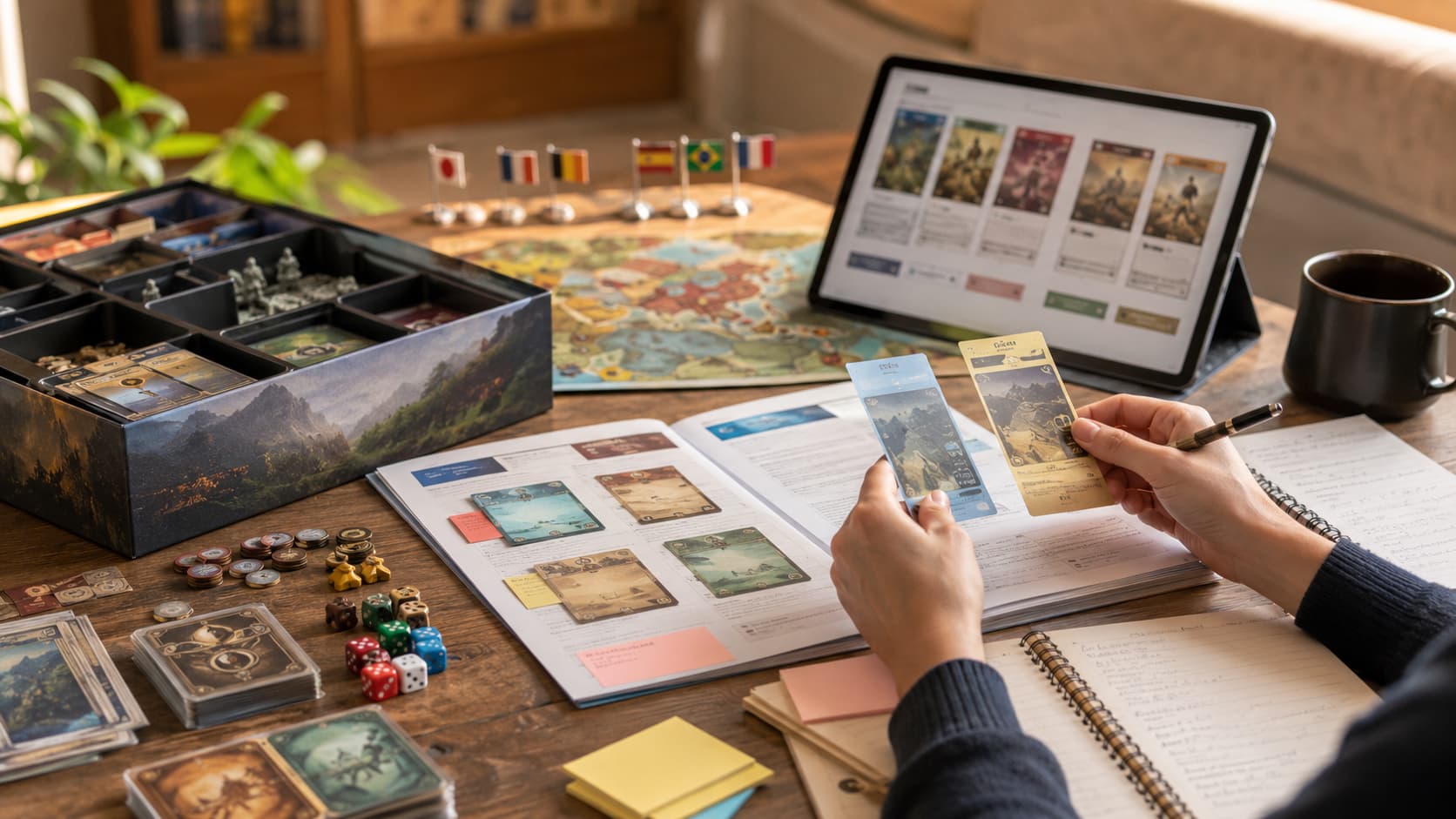
The first thing that makes board games uniquely hard to translate is that the text is functional, not decorative. In a novel, a slightly clumsy sentence is a blemish. In a board game, a slightly clumsy sentence in the rulebook can break the game. Every component has to stay consistent with every other: a keyword printed on a card must match the keyword defined in the rules, which must match the term used on the board and on the player aids. Translators describe the goal as making all these parts harmonious and consistent with one another, so that they guide players through the necessary actions without creating misunderstandings.
This is why a single mistranslated term is so dangerous. If a card refers to an action using one word and the rulebook explains it using another, players are left arguing over what is actually allowed. The translator is not just rendering prose; they are maintaining the internal logic of a rules engine across an entire box of interlocking text. Professionals handle this by building terminology databases before they translate a word, so that the same concept is rendered identically everywhere and stays consistent across future expansions too. Without that discipline, inconsistency creeps in and the game slowly becomes incoherent.
Rules must be clear before they can be faithful
There is a tension at the heart of rulebook translation between fidelity and clarity, and clarity usually has to win. A rulebook exists to be understood, instantly and unambiguously, often by people reading it aloud to friends who are waiting to play. A translation that is technically accurate but convoluted has failed at the one job that matters. The best localizers therefore treat the rulebook less as a passage to translate and more as an instruction manual to rebuild in the target language, sometimes restructuring sentences entirely so a rule lands cleanly.
This is also where the localizer becomes a kind of proofreader for the original. Because translating forces someone to interrogate every rule with extreme care, translators routinely discover ambiguities, contradictions, or outright errors in the source text that the original designers never noticed. A good localization process includes a channel for the translator to flag these problems back to the publisher, which means a careful translation can actually improve the game in every language, including its first one.
The peculiar problem of the title
Names are their own battlefield. A game’s title is its single most important piece of marketing, and translating it badly can doom a release before anyone reads a rule. There are several strategies, each with traps. Sometimes the smartest move is to leave the title untranslated, especially when it is an invented word with no meaning to translate. The famous stacking game Jenga takes its name from a Swahili word meaning “to build,” but to most of the world it is simply a brand, a coined word that needs no translation and travels intact.
Other titles depend on a pun, a cultural reference, or a double meaning that simply does not exist in the target language. Here a literal translation is often the worst option, producing something that is grammatically correct but lands oddly on native ears, a phrasing that feels subtly foreign even when every word is technically right. The localizer must decide whether to invent a new title that captures the original’s spirit, adapt it loosely, or keep the source name. The right answer depends on the market, and getting it wrong signals carelessness to potential buyers from the very first glance.
When the theme itself does not translate
Beyond rules and names lies the deepest challenge of all: the theme. Board games are increasingly defined by their setting, their flavor, the little snippets of story that wrap the mechanics. And theme is saturated with culture. Humor, idioms, historical references, and imagery that delight players in one country can fall flat, confuse, or even offend in another.
This is where translation shades into genuine cultural adaptation. A joke on a card may need to be rewritten as a different joke that produces the same laugh. A reference to a folk tale everyone knows in the source country may need to be swapped for one the new audience recognizes. Imagery and symbols sometimes have to be altered to respect local norms and regulations, since different countries have very different rules about depictions of violence, religion, and politics. The aim is not slavish literalism but preserving the original essence while making it resonate locally, and that often means changing the words considerably to keep the feeling the same.
The difficulty of this scales with what scholars call cultural distance. Translating between two neighboring European cultures is one thing; bridging a wide cultural gap, such as between East Asian and Western audiences, demands far more than language skill, requiring deep knowledge of both cultures to avoid producing something baffling or inadvertently inappropriate. The further apart the cultures, the more the localizer must become an interpreter of meaning rather than a converter of words.
Why only a gamer can do it well
All of this explains a truth that the localization industry repeats constantly: it is not enough to be an excellent translator. You also have to live and breathe board games. A linguist who does not play will not catch that a rules keyword has a precise mechanical meaning, will not notice when a translated phrase accidentally implies an illegal move, and will not feel when a theme has lost its charm. The best board game translators start by learning to play the game, getting to grips with its rules, setting, and style before touching the text, approaching the work with their gamer’s hat on first and their translator’s hat second.
There is also a charming wrinkle unique to this hobby. Tabletop culture is a deeply participatory fan culture, and for smaller languages that no publisher will pay to support, devoted fans often step in to translate games themselves, simply so their friends can play. This grassroots localization keeps countless titles alive in languages the market would otherwise ignore, a reminder that translation, at its heart, is an act of welcoming someone new to the table.
The invisible craft
When localization is done well, no one notices it, which is precisely the point. Players in a dozen countries each feel as though the game was made for them, the rules crystal clear, the title catchy, the theme alive. When it is done badly, the seams show everywhere: contradictory cards, a baffling title, jokes that thud, rules that spark fights. A board game is a machine for producing fun, and localization is the delicate work of rebuilding that machine in another language without losing a single gear. It deserves far more credit than it gets.